Genesis · The content operating layer · In service
Don’t just post. Post with intelligence.
Genesis joins client knowledge, market context, content, approvals, publishing and evidence into one controlled workflow. Your team sees what needs attention now, prepares it under review, and publishes with a recorded approval behind every post.
What Genesis is
Genesis is the operating layer for content. It is built for small and growing service businesses, and for the marketing teams and agency operators who manage their posting, so that audience choices, the content workflow and the measured response finally live in one place instead of three.
Most businesses post regularly and cannot say clearly what the posting learned them. The work is scattered across chats, sheets and dashboards; the approvals happen somewhere unwitnessed; the results arrive without a home. Genesis is where that signal stops leaking.
Four rooms, one view
Everything a content decision needs sits in one controlled view:
Mission Control
What needs your attention now: the recommendation on the table, the state of the publishing engine, and where each client's work stands.
Market Intelligence
Knowledge about the client and their market, held as context rather than scattered notes, and assessed for readiness before it feeds anything.
Content Studio
Drafts, reviews, the calendar and the pipeline. Ideas move through a visible workflow instead of hiding in chats.
Growth
Reach, response and enquiries recorded separately, at fixed checkpoints, so the next content decision starts from evidence.
Built for
Teams that post regularly and want the posting governed: a service business whose content is a real channel, a marketing lead running several clients, an agency operator who needs approvals and evidence visible, not verbal.
The common shape: more activity than system. Genesis supplies the system.
Not built for
A single channel posting twice a month does not need an operating layer; a spreadsheet does that job. And if the whole system already runs in one place, Genesis duplicates it rather than improves it.
We say so when we meet those cases. The audit exists to find where the signal actually leaks, or to point you somewhere cheaper.
How the workflow runs
Context
Market Intelligence feeds the brief: what the client knows, what the market is doing, whether the profile is ready. Missing context is named rather than assumed.
Plan
In Content Studio, drafts move through a visible pipeline: written, reviewed, scheduled for the channels you have approved. Plan. Review. Publish.
Approve
Recommendations carry their reasoning. The responsible human approves with that basis visible — and approving a post’s schedule is the final word on it firing.
Nothing fires without you
Every post goes out only under a recorded per-post approval. Change a post after approval and the approval is void until somebody approves it again. Destination locks keep each channel exactly as configured.
Learn
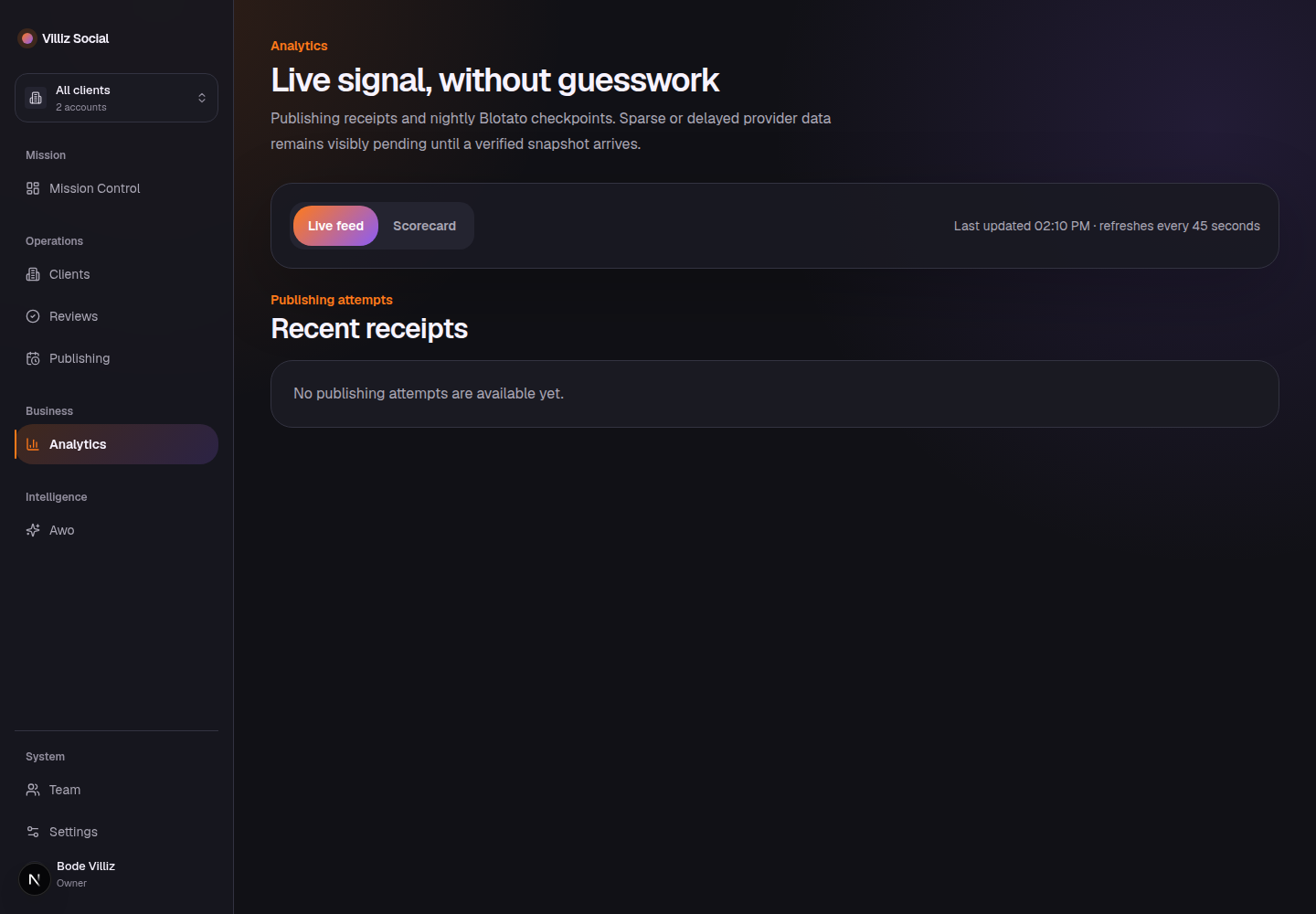
Growth records reach, response and bookings at fixed checkpoints — separately, so you can see which content actually moved the business before the next decision.
What you receive
The workflow set up with your real context. An audit report showing where your content system is losing signal and what to improve next. Governed publishing with receipts: every approval and every publish leaves an auditable trace, so the history of who said yes to what is never a matter of memory.
And a system that ages well: as the evidence accumulates, the recommendations get sharper about what to make next for your particular audience.
The authority rule
Nothing publishes without real human authority. Every post requires an explicit, recorded approval from the person accountable for it — per post, not per week. A recommendation informs the decision; it never makes it, and the system plainly shows when a basis for it is thin.
No internal-use exception, no just-for-a-test, no assumed consent when someone works for the client. If the arrangement ends, the authority ends with it. We would rather lose an engagement than run this in the dark.
This is not overhead. It is the condition the product is for — the thing we tell you first rather than last.
What we don’t promise
Evidence, not guesswork. The numbers in Genesis are genuine or visibly empty; the system will not manufacture a metric to make a screen look complete. It will not claim an audit happened when one has not, and it will not promise you a result before the evidence exists.
That restraint is the point. A content system you can trust is one that will show you an empty field.
The first step
Every Genesis engagement starts with a Social Growth Audit: a working session that maps where your content system is losing signal — scatter, weak approvals, unread evidence — and what to improve first. No commitment beyond the audit. You keep the findings.
Book the audit
Write to hello@villiz.co.uk with a line about your posting rhythm and who manages it, and we will book the audit. If the audit shows you don’t need Genesis, we will say that too — the audit is where we find out, together.